
LESSON PLANS
Subject : English Language
Topic: Exploring Descriptive Writing Using Adjectives and R-Controlled Vowels
Grade Level: 7
Duration: 2 weeks
Objectives:
● Students will identify and classify at least 3 types of adjectives (e.g., descriptive, quantitative,
demonstrative).
● Students will recognize and use at least 5 R-controlled vowels in reading and writing activities.
● Students will apply their knowledge to collaboratively create a descriptive paragraph in groups of
4s
Lesson Plan Outline
Engage (10 minutes)
● Activity: Show students a picture of a woman washing at the riverside (or any engaging scene).
○ Ask students to describe what they see using adjectives. Write their responses on the
board, sorting them by types (descriptive, quantitative, demonstrative, etc.).
○ Highlight any R-controlled vowel words in their descriptions (e.g., "forest," "corner,"
"bark").
● Question: "How do adjectives and sounds of words help us imagine and feel the scene better?"
Explore (10 minutes)
● Activity 1: Provide a short descriptive passage (e.g., about a garden, ocean, or park) that
includes various adjectives and R-controlled vowels.
○ Example: "The farmer's barn was surrounded by golden cornfields, and the air was crisp
and warm."
○ Students work in pairs to highlight adjectives in one color and underline R-controlled
vowels in another.
● Discussion: Share findings as a class and talk about the purpose of adjectives and the unique
sound of R-controlled vowels.
Explain (15 minutes)
● Mini-lesson on Types of Adjectives:
○ Explain and give examples of:
■ Descriptive adjectives: Big, blue, shiny.
■ Quantitative adjectives: Three, many, several.
■ Demonstrative adjectives: This, that, those.
● R-Controlled Vowel Explanation:
○ Teach how vowels followed by "r" create a unique sound (e.g., ar, or, er, ir, ur). Provide
examples like “car,” “bird,” “corn,” “turn,” “farmer.”
● Use interactive slides or anchor charts for visuals.
Elaborate (20 minutes)
● Project-Based Activity: Create a collaborative descriptive paragraph.
○ Split students into small groups.
○ Each group selects a theme (e.g., a magical forest, a bustling city, or a mysterious cave).
○ Groups brainstorm adjectives (at least one of each type) and include R-controlled vowel
words in their descriptions.
○ Groups write and decorate their paragraphs on chart paper or digitally.
● Extension: Students underline R-controlled vowels in their writing and circle adjectives.
Evaluate (5 minutes)
● Peer Review: Groups present their paragraphs. Peers give feedback on how well the writing
included adjectives and R-controlled vowels.
● Quick Check: Individual exit ticket – Students write one sentence that includes:
○ One adjective of each type.
○ At least one R-controlled vowel word.
○ Example: "This large farm has five cornfields and a warm barn."
Materials Needed
● Pictures/scenes for engagement activity.
● Descriptive passage for exploration.
● Markers, chart paper, or digital tools for group work.
● Anchor chart or slides on types of adjectives and R-controlled vowels.
Subject: English Language Topic : Reading
Focus Skill Vocabulary Development
● Homophones
● Differences in Non-standard and standard English structures. Grade 7e, 7r, 8o
Date February 17, 2025 Duration One week
Unit Title Adopting Positive Behaviour
Focus Question: What are Positive Behaviours and how do I adopt them?
ATTAINMENT TARGET: Recognise, value, and make distinctions between home language and SJE to
improve/acquire language and literacy competencies
GENERAL OBJECTIVES:
• Respond to the creative use of different language forms
• Respond to the appropriateness of diction for audience.
SPECIFIC OBJECTIVES
At the end of the lesson students should be able to:
● Identify 10 unfamiliar words.
● Dramatise the reading of at least 5 sentences to demonstrate the use of direct and indirect
speech.
● Identify 2 pairs of homophones in the story.
● List 8 additional pairs of homophones.
● Translate at least 10 non-standard sentences in standard English
● Match the scientific words in column A with their corresponding meanings in column B.
● Work in groups of 4s to construct paper planes.
SCOPE AND SEQUENCE
Unit 2
Work cooperatively with their peers to examine strategies used to decode and decipher the
pronunciation and meaning of unknown vocabulary.
Use varying levels of context clues to identify, extract and clarify the meaning of words.
Apply a variety of spelling and pronunciation rules in decoding unfamiliar vocabulary in isolation
and in context.
Focus Skills
Vocabulary Development
● Homophones
● Differences in Non-standard and standard English structure
● Direct and Indirect Speech (revised). Pre-requisite Skill - Homophone awareness.
CONTENT
Story: "The Great Plane Adventure"
One sunny morning, the Wright family stood on the shore, watching waves crash against the sand. Sam
and Lily, two curious kids, were eager to soar through the sky. Their father, Mr. Wright, was a
pilot who loved teaching his kids about planes.
“We’ll build a plane today!” Mr. Wright declared.
Whe u se daddy? Plain or plane? asked Sam, confused.
“A plane—something that flies, not the flat, plain land,” Mr. Wright chuckled. Lily grinned. “Can
we paint it too? I don't want it to be plain and boring!”
Soon, they were working hard. They nailed wooden pieces together, careful not to hit their thumbs.
Mr. Wright explained how the wings needed to be strong enough to lift the plane off the ground.
“You need the right materials,” he said.
“Right? Like the Wright brothers, our name?” Lily joked. “Exactly!” said Mr. Wright.
When they finished, the plane looked magnificent. They launched it down a hill. The wind carried it
far and high.
“Tidey a di bes day!” Sam shouted, feeling the wind rush past his face. Lily nodded. “Dis ya plane
baad, wi leern a heep a tings tidey!!!”
The family celebrated their plane's success as it glided back to the ground.
5E STEAM Lesson Plan: "The Great Plane Adventure"
DAY 1
STRAND: Listening and Speaking
1. Engage
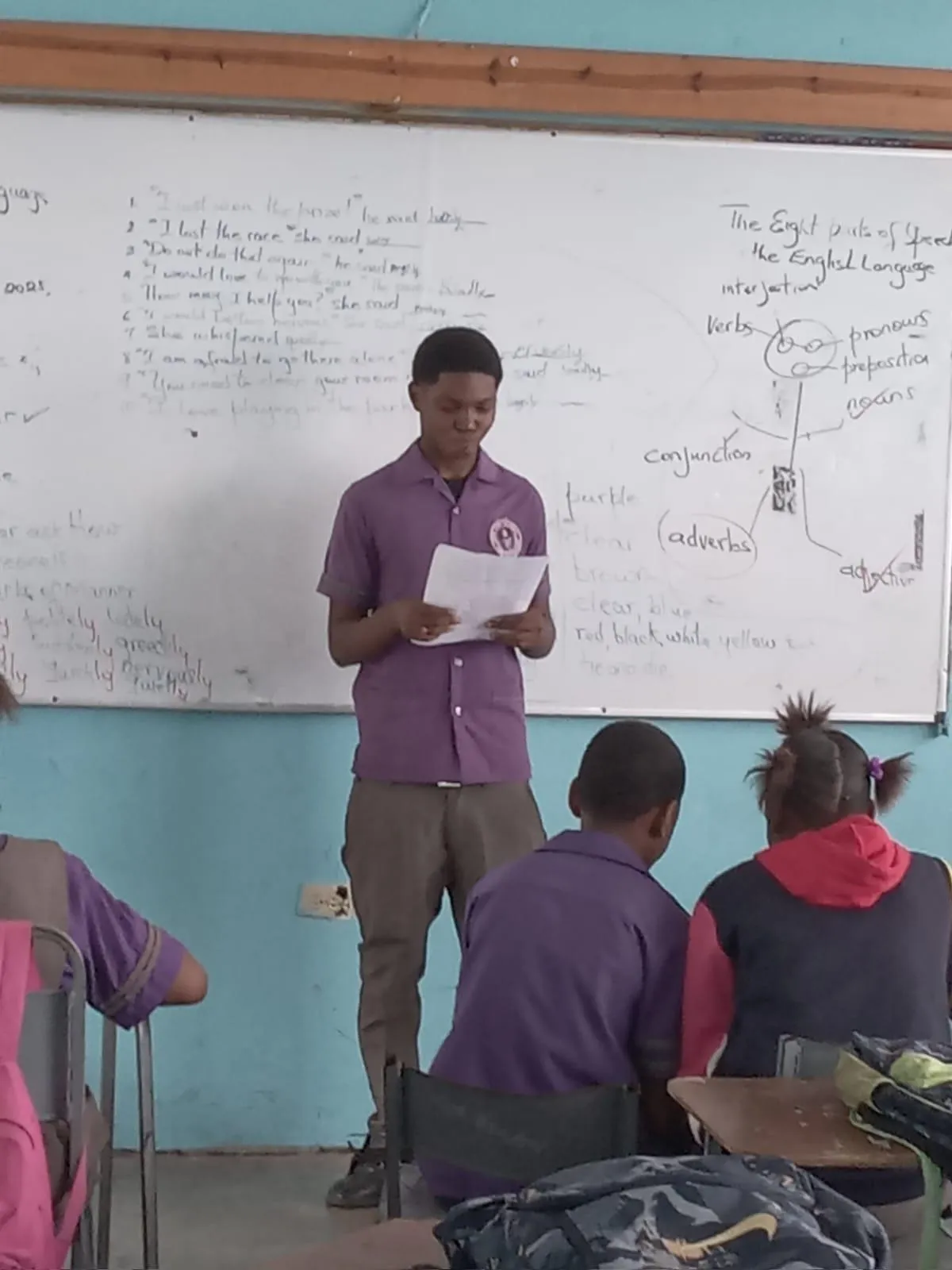
● Read and Roleplay "The Great Plane Adventure" story aloud.
● Why do you think the children spoke in patois?
● Can you translate the patois to standard English?
● Ask: "What homophones did you notice in the story? Why are homophones tricky?"
● Show examples of "plane" vs. "plain" and "right" vs. "wright."
● Discuss: How do planes fly?
DAY 2
2. Explore
STRAND : Comprehension/Grammar
a) Students will identify the main idea and supporting details from the story (The Great Plane
Adventure)
b) Demonstrate positive behaviour in groups while:
● Gathering basic materials (cardboard, paper, wooden sticks, rubber bands).
● Building a simple glider model that can fly at least 5 feet.
● Experimenting with wing shapes and sizes.
DAY 3
STRAND: Word Recognition and Fluency
3. Explain
● Discuss the science vocabulary of flight: lift, thrust, drag, and gravity. Reference 1
https://www.google.com/search?
q=the+science+of+flying+aeroplanes&sca_esv=14f1bb877078fccd&authuser=
Reference 2https://chandra.si.edu/make/images/paper_airplanes.pdf
Use homophones related to the project (e.g., “plain vs. plane,” “right vs. write”) in context.
Reflect on how engineers test and refine designs.
DAY 4
STRAND: Study Skills and Research/Writing/ Grammar/Language Structure.
4. Elaborate
Students will write simple sentences in sequence about how they used STEAM to make their planes.
The teacher will facilitate grammar and conventions.
○ Science: Aerodynamics
○ Technology: Research different plane types
○ Engineering: Refine design
○ Art: Decorate the planes creatively
○ Math: Measure flight distances and angles
Students will use the dictionary to find the difference in meanings of additional homophones
5. Evaluation 1
● Students present their planes and explain their design choices.
● Assess understanding with guiding questions:
○ "What changes did you make and why?"
○ "How did homophones in the story add to the learning experience?"
● Conduct a friendly plane-flying competition to test designs.
Evaluation 2
● Identify unfamiliar words.
● Dramatise the reading of sentences to demonstrate the use of direct and indirect speech.
● Identify pairs of homophones in the story.
● List additional pairs of homophones.
● Translate non-standard sentences in standard English
● Match the scientific words in column A with their corresponding meanings in column B.
● Work in groups of 4s to make presentations of plane constructions.
Exit Ticket
At the end of the week, students will be required to write or say one way they adopted positive
behaviour.

Thank you for submitting your lesson plan!
If you have completed your quizzes, you can check your certificate status now by entering your email address at the IVLST Certificate Centre. Be sure also to print a copy of your lesson plan and add it to your e-portfolio.
 | STEP 1. LESSON CONTEXT |
 | STEP 2. GOALS AND RESOURCES |
| STEP 3. LESSON PLAN |
| Pre-lab activity List any activities taking place before introducing the lab or simulation, such as a lecture or demonstration. |
| Open play activities List any initial exploratory activities the students will undertake with the lab or simulation. |
| Teacher will... | Students will... |
| Simulation-centred activity Describe the core activity students are expected to complete through the lab or simulation. |
| Teacher will... | Students will... |
| Discussion and summary What will you and your students do to reinforce reflective practices and critical thinking? |
| Teacher will... | Students will... |
 | STEP 4. ACCESSIBILITY, EQUITY, AND INCLUSION |
Contact
© Copyright 2025. All rights reserved.